 Shop
Shop
-1.png)


eStoreRx™
Online Supplement Dispensary
eStoreRx™ is an easy direct-to-patient ordering & fulfilment program for lifelong wellness.
The newly released 2025-2030 Dietary Guidelines For Americans have generated quite a bit of buzz! This is the tenth iteration of the guidelines, updates to which have been released every five years beginning in 1980. While some recommendations have been carried forward from previous versions, this update also includes significant departures on issues that have stirred up controversy and debate. The current version encompasses numerous changes and departures from previous iterations, but here are a handful of the most notable ones.
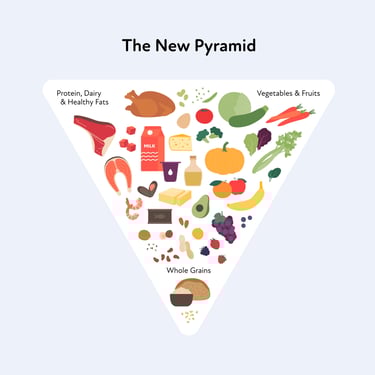
The biggest change is the one that’s hardest to miss, since it’s featured right on the cover page of the report: the inversion of the iconic (and perhaps infamous) food pyramid image. First unveiled in 1992, the Food Guide Pyramid featured grain-based carbohydrates at the bottom, with dairy products and foods higher in fat and protein closer to the top, with a caution to use added fats, oils, and sweets sparingly. The 2025 guidelines continue recommending avoidance of added sugar and highly processed foods, but whole-food proteins – including full-fat dairy products – are now at the top, alongside vegetables and fruit, while whole grains have been moved to the smallest point at the bottom.
Another point of departure from previous iterations of the guidelines is an increase in the recommended daily protein intake. The new guidelines recommend 1.2-1.6 grams of protein per kilogram of body weight per day, which is significantly higher than the current Recommended Dietary Allowance (RDA) of 0.8 g/kg/d. The scientific foundation underpinning the guidelines states:
“The current Recommended Dietary Allowance (RDA) for protein—0.8 grams per kilogram of body weight per day—was established to prevent deficiency based on nitrogen-balance data. It represents the lowest intake that maintains equilibrium in most healthy adults but does not reflect the intake required to maintain optimal muscle mass or metabolic function under all conditions.” (Emphasis added.)
“Overall, the evidence supports that protein intakes well above the RDA are safe and compatible with good health and may confer functional advantages for preserving muscle and metabolic resilience, particularly in individuals who are physically active or undergoing weight loss.”
It is further noted in the scientific foundation that the Acceptable Macronutrient Distribution Range (AMDR) for protein was set by the National Academies at 10-35 percent of total calories for adults, which could translate to as much as 2.5 g/kg/d at the upper end. So even the high end of 1.6 g/kg/d in the new guidelines is still well below a reasonable protein intake.
Concerns have been raised about potential adverse effects from increased protein intake, but a large body of research indicates that protein intakes higher than the previous recommendation do not increase risk for kidney damage or negative impacts on bone health. To the contrary, higher protein diets may be beneficial for various reasons, such as weight management and reducing risk for sarcopenia.
The scientific foundation for the new guidelines reveals that the committee rejected potential recommendations to “Include more nutrient-dense plant-based meal and dietary
recommendation options” and “Modify the dietary pattern to emphasize dietary intakes of beans, peas, and lentils while reducing intakes of red and processed meats.” While still including peas, beans and legumes as sensible plant-based sources of protein, the guidelines now also explicitly give a green light to “Consume a variety of protein foods from animal sources, including eggs, poultry, seafood, and red meat.”
Shifting from protein to fat, animal foods (specifically “meats, poultry, eggs, omega-3–rich seafood”) are recognized as a source of “healthy fats” in addition to fat from plant sources, such as nuts and avocados. Butter and beef tallow are mentioned as acceptable options for cooking or adding fat to meals. This is a departure from the previous iteration of the guidelines, which recommended “cooking with vegetable oil in place of fats high in saturated fat, including butter, shortening, lard, or coconut oil.”
However, consistent with previous versions of the guidelines, the current iteration continues to recommend a 10 percent cap on saturated fat as a percentage of total daily calories, despite questions being raised about whether this limit is evidence-based. Numerous commenters have pointed out that this cap is inconsistent with embracing a whole foods diet that may include eggs, full-fat dairy foods, beef, pork, and other protein foods that tend to be higher in fat. Having just a few servings of these would quickly put someone over the 10 percent limit. Additionally, numerous meta-analyses going back more than a decade have noted that there is no association between saturated fat intake and risk for cardiovascular disease. Newer analyses have confirmed this, including one published in the Journal of the American College of Cardiology, which stated, “There is no robust evidence that current population-wide arbitrary upper limits on saturated fat consumption in the United States will prevent CVD or reduce mortality.”
The 10 percent cap on saturated fat also seems internally inconsistent with what the scientific foundation used to establish the guidelines. The committee chose not to “reaffirm current guidance to lower consumption of butter and replace butter with vegetable oils that are higher in unsaturated fatty acids”, nor to “promote replacement of plant sources higher in saturated fat, such as coconut oil, cocoa butter, and palm oil, with vegetable oils higher in unsaturated fats.” So, it’s somewhat perplexing that the recommendation is to consume no more than 10 percent of one’s calories from saturated fat, despite the committee rejecting the message to caution people away from saturated fat and toward use of vegetable oils. In fact, the committee’s own scientific foundation states: “A half century of research has not confirmed that lowering saturated fat below 10% of energy—or substituting it with linoleic acid–rich oils—reduces coronary heart disease or mortality risk. Overall, causal evidence does not demonstrate cardiovascular or mortality benefit from lowering saturated fat below current population averages.” (Emphasis added.)
Something else worth noting about guidance on fat intake is the shift from emphasis on low-fat dairy products to endorsing full-fat dairy. Previous iterations of the guidelines have cautioned against full-fat dairy, steering the public instead toward reduced fat dairy foods.
The scientific foundation noted: “Despite enduring guidance to replace whole-fat dairy with low-fat products, there is a remarkable lack of evidence from RCTs and observational studies demonstrating adverse clinical consequences of whole-fat dairy in adults or children.” The committee noted that dairy is “an excellent source of protein, healthy fats, vitamins, and minerals,” endorsing consumption of “full-fat dairy with no added sugars.”
The new guidelines emphasize limiting sugar intake, particularly refined sugars and sugars coming from highly processed foods. Limiting sugar has been a mainstay of the guidelines since their first release in 1980, but the current iteration seems to come down harder on sugar than past versions did. The previous guidelines (2020-2025) recommended that added sugars make up “less than 10 percent of calories per day starting at age 2.” The new guidelines are a bit stricter, stating, “While no amount of added sugars or non-nutritive sweeteners is recommended or considered part of a healthy or nutritious diet, one meal should contain no more than 10 grams of added sugars.” Having just one sugar-sweetened soft drink would put someone over the limit for a meal.
Proponents of lower-carbohydrate diets have noted the mention of carbohydrate restriction specifically for the many millions of Americans living with chronic disease: “Individuals with certain chronic diseases may experience improved health outcomes when following a lower carbohydrate diet.” The scientific foundation details the public health crisis and economic burden owing to the prevalence of chronic metabolic diseases like obesity, type 2 diabetes, and insulin resistance, which can be improved through reducing carbohydrate intake.
The focus on limiting sugar and highly processed foods extends to grain consumption as well. The guidelines have long emphasized opting for whole grains and limiting refined grains, but the new iteration limits total grain consumption more than in the past, with “goals” being 2-4 servings per day, adjusting based on individual needs. It’s still recommended that grain intake be at least 50 percent whole grains, but the scientific underpinnings include the caveat that “many processed foods labeled as ‘Made with Whole Grain’ or ‘Multigrain’ contain mostly refined grains.” This is important, because marketing language may lead consumers to think they’re making a better choice when the ingredients don’t stand up to scrutiny. It’s actually stated outright: “Refined grains are sugar in disguise.” While the guidelines recommend 2-4 servings of whole grains per day, that amount can be adjusted based on individual caloric needs – a caveat that also applies to fruits and vegetables, protein, and dairy foods.
The new guidelines contain other noteworthy details, but the ones explored here have been receiving the most attention recently.

Submit your comment